Showing posts with label food. Show all posts

Friday, August 6, 2010

Picking Tomatoes

This, dear friends, is a Green Giant tomato, and it's one of my favorites. I know you won't believe me, but it smells like BLTs. I can press my nose against it and pick up not only the sweet scent of tomato, but also mayonnaise and peppery bacon. It is truly amazing.

A few days ago, while making a tomato salad for dinner, I bit into a Black Cherry tomato, sighed happily, and was about to tell my mom that if I ever lived in a place where I only had room for one tomato plant, that would be it. But it came out like this: "If I could only grow one kind of tomato, well, no, if I could only grow two kinds of tomatoes, no, if I could only grow three kinds of tomatoes..."

I have since come to the conclusion that I will always need to live in a place where I can grow at least four kinds of tomatoes: a Black Cherry for snacking and salads, a Flamme for oven-roasting, a Speckled Roman for sauces, and a Green Giant for sandwiches.

There's a reason they call tomatoes like the Green Giant beefsteaks, and here it is:

In my opinion, anything that I can pick from its vine, sniff happily, and put on toast is a very good thing.

Tuesday, April 20, 2010

Lunatic Farming

On Sunday, Aaron and I drove up to the University of Minnesota to attend a lecture given by Joel Salatin. Joel is a bit of a pioneer in sustainable agriculture and pasture farming, and he is featured in Michael Pollan's The Omnivore's Dilemma and the documentary Food, Inc. The lecture was titled, "The Sheer Ecstasy of Being a Lunatic Farmer."

When I was a senior in college in Virginia, several of my classmates and I took a day trip to Polyface Farm as part of a class on food systems. It was one of the most inspiring trips I have ever taken, because it illustrated so clearly that what Joel preaches is possible. And that is, this:

That farming can be environmentally conscious, and not only that, but also environmentally beneficial, because carefully managed grazing can enrich soils and encourage the return of native plant species.

That there is a moral thread that runs from the field to the fork. While many in our agricultural system view life in a manipulative or cruel way, there are farmers out there who are allowing their "pigs to express pigness." By allowing a plant or animal to express itself, we can move toward respect in our food system.

That we can attract more people to agriculture by "romancing" them onto the farm - that is, by creating farms that are aromatically and aesthetically pleasing. And that instead of encouraging our brightest students to leave rural areas, we need to create a farming system that attracts them. Farmers are, after all, the stewards of our land, air, and water.

And finally, that it should be our mission to bring beauty and healing to everything within our sphere of influence.

There are a lot of people today who don't want to think about where their food came from. They don't want to visit the CAFO where their meat was raised, and even if they did, in many places they wouldn't be allowed in. But I think many people enjoy watching the ballet that occurs on diversified farms where animals are raised on grass.

When I was walking through Polyface, it was incredibly clear to me that this was how I, or anyone else, could leave a positive mark on the world. I thought of the pigs that could clear the underbrush from our native oak savannas, the cows that could, through rotational grazing, calm thistles and encourage the growth of prairie grasses. Thriving rural communities, and, at its simplest level, good food.

When I imagine a future where such practices would be considered normal, and not lunacy, I could cry.

Sunday, April 18, 2010

A Conundrum

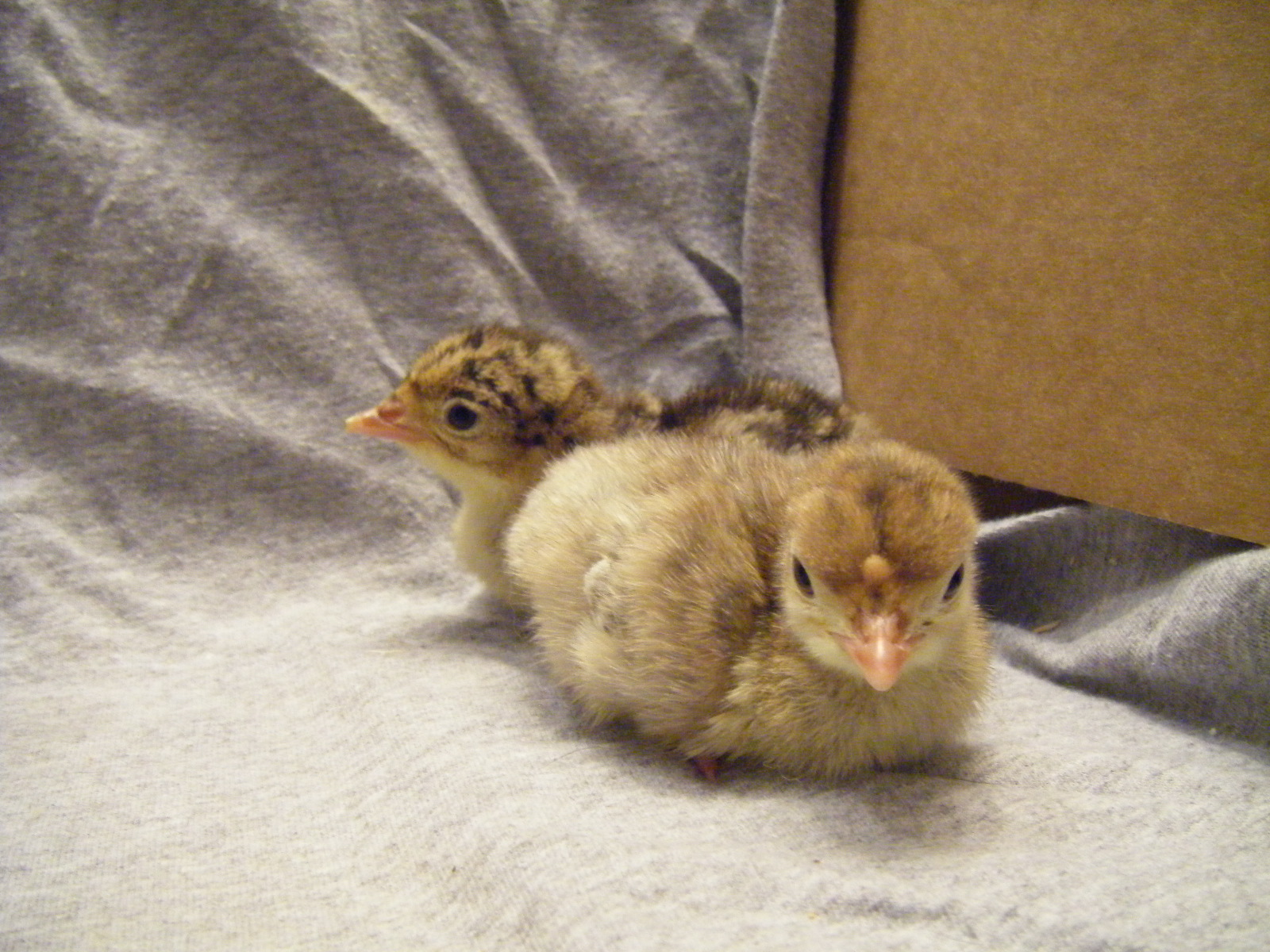
Yesterday I picked up three day-old poults. I'd ordered them with the intention of raising my own Thanksgiving turkey this year. I had originally wanted two, but the man who sold them to me had one extra, and he told me over the phone that he thought that once I got there and saw them, I'd want to take them all home.

He knew my weakness but not to its fullest extent - I wanted them all before I even hung up the phone.

So now I have three more downy babies, and one little problem. Because no one warned me that baby turkeys would be this cute - so wobbly on their long legs and hopelessly clueless, with large eyes and sweet triangular beaks.

If I have a hen or two in here, then goodness. I had dreamed of home-grown roast turkey, but come Thanksgiving I might be grateful instead for the makings of a little breeding flock out in the barn.

Thursday, April 15, 2010

Growing Food


I start tomato plants in my bedroom. They're growing wild, and every morning I have to do a little rearranging to keep the tops from brushing against the lights. When I touch them they release their green, spicy scent - one of my favorite smells.

Outside, the radishes, peas and spinach are poking their little green heads above the soil, and I dream of green salads.

I love food, and I love it even more when I know where it came from and who cared for it. When I eat a salad in a restaurant, I don't think about it in any agricultural sense. I may think about its taste and texture, but nothing about where it grew, and whose hands were involved in its planting and harvesting.

But when I make a salad from plants I've grown myself, or bought from neighbors, it has a story. I order the seed, plant it, water it, fuss over it as I wait for it to grow. And finally, I cut it, wash it, top it with sliced multi-colored radishes. Maybe I'll make a little dressing with blue cheese aged in caves an hour away. In this way, food connects me to my community. I am not only a consumer, but a participant in a cycle that begins every year with birth. And by this choice, I hope to have a greater understanding, as Wendell Berry writes, "that eating takes place inescapably in the world, that it is inescapably an agricultural act, and that how we eat determines, to some considerable extent, the way the world is used."

This is why, when I spend money on food, I try to support my neighbors and agricultural systems that honor land, family, and animals. My family buys grass-fed beef and pastured pork and poultry because we want to know that the animals that died to feed us had good lives, and that they were able to live in a way that honored their cow, pig, or chicken natures.

This year, I'm raising some of my own meat birds. My chicks are my babies, my little darlings. I love them and I'll give them the best life that I can, but one day they'll grow up, and I'll pack most of my boys into the car and take them to Callister Farm for processing. I'll be sad and I'll miss them but I'll also be incredibly thankful. When I roast one of my own birds, knowing the part I played in its life and death, I will remember two things that Berry wrote:

First, "Only by growing some food for yourself can you become acquainted with the beautiful energy cycle that revolves from soil to seed to flower to fruit to offal to decay, and around again. You will be fully responsible for any food that you grow for yourself, and you will know all about it. You will appreciate it fully, having known it all its life."

And second, "Eating with the fullest pleasure - pleasure, that is, that does not depend on ignorance, is perhaps the profoundest enactment of our connection with the world. In this pleasure we experience and celebrate our dependence and our gratitude, for we are living from mystery, from creatures we did not make and powers we cannot comprehend."

Thursday, March 11, 2010

Cookies and Rain


We're having our first rains of the year, along with the kind of gray skies that make indoor spaces feel cave-like. It's the kind of weather that makes me want to just migrate from bed to couch, watch Colin Firth play Mr. Darcy, and make something sweet.

My dad and I love these cookies. They didn't quite turn out this time - they never really set. I don't know if it's because I tried adding less sugar, or because I let the sugar mixture boil a little too long while I was measuring out the other ingredients. Despite the flawed presentation, they are still delicious!

Here's the recipe. They're so easy and hardly make any mess - perfect for lazy mornings or quick weeknight desserts.

Unbaked Chocolate Oatmeal Cookies

2 cups sugar
1/2 cup milk (regular or evaporated)
1/2 cup butter
1/2 cup cocoa
3 cups rolled or quick oats
1 teaspoon vanilla
1/2 cup chunky peanut butter (optional)
1/2 cup coconut (optional)
1/2 cup nuts (optional)

Bring sugar, milk and butter to boil in saucepan. Boil exactly 1 minute. Remove from heat and add oats, cocoa, vanilla, and optional ingredients if desired. Quickly drop by tablespoon full onto waxed paper. Let cool.